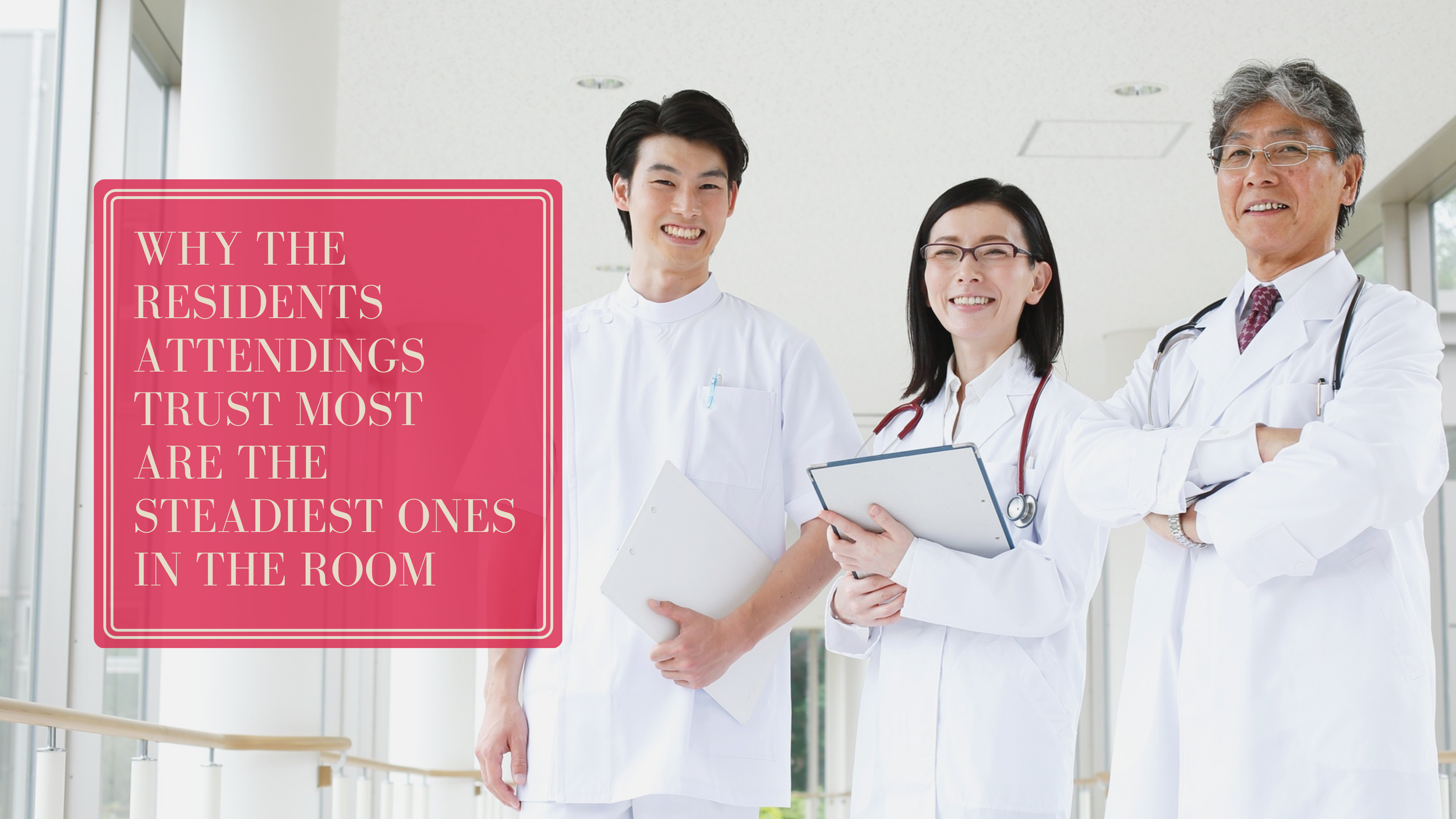
Why the Residents Attendings Trust Most Are the Steadiest Ones in the Room
In high-pressure clinical environments, trust is built faster than most residents realize.
It isn’t built by being the loudest voice on rounds.
It isn’t built by answering the fastest.
It isn’t built by trying to prove how much you know.
The residents attendings trust most tend to share one quiet trait.
They stay steady when things get chaotic.
Steadiness Is What People Actually Read as Competence
In moments of uncertainty, people don’t just evaluate what you say.
They evaluate how you say it.
When your thinking remains steady under pressure, several things happen at once.
You make sharper decisions instead of reactive ones.
You ask clearer, more precise questions.
You communicate in a way that lowers tension instead of adding to it.
Attendings feel this immediately, often before they consciously register why.
Steadiness signals reliability.
Reliability builds trust.

Calm Is Not a Personality Trait
Many residents assume calm is something you’re either born with or not.
They look at colleagues who seem unflappable and conclude they simply have the right temperament for medicine.
But calm is not a fixed trait.
It is a skill.
Specifically, it is the ability to regulate your thinking and communication under pressure.
And like any clinical skill, it can be trained.
Why Language Matters More Than You Think
One of the fastest ways to build steadiness is through language.
The words you choose shape the moment in real time.
Certain phrases escalate tension, even when your intentions are good.
Others slow the room down, clarify priorities, and create psychological safety.
When you use language that reflects grounded thinking, you signal that you can be trusted with responsibility, uncertainty, and complexity.
This is not about sounding polished.
It is about choosing words that align with clarity rather than stress.
Calm Communication Changes How You Are Perceived
Attendings don’t just assess medical knowledge.
They assess whether you can:
Think clearly when information is incomplete
Communicate without amplifying stress
Stay oriented when the situation shifts
Residents who can do this consistently are remembered.
Not because they dominate the room.
But because they stabilize it.

Steadiness Is Built, Not Discovered
Calm does not appear once training gets easier.
It develops when you practice regulating your thinking and language while training is hard.
When you build this skill, trust follows naturally.
Not because you demanded it.
But because people feel safer working with you.
If you want support building steadiness, calm communication, and trusted presence under pressure, the next step is a consultation.