Why High-Achieving Residents Feel Disconnected From Their Own Lives
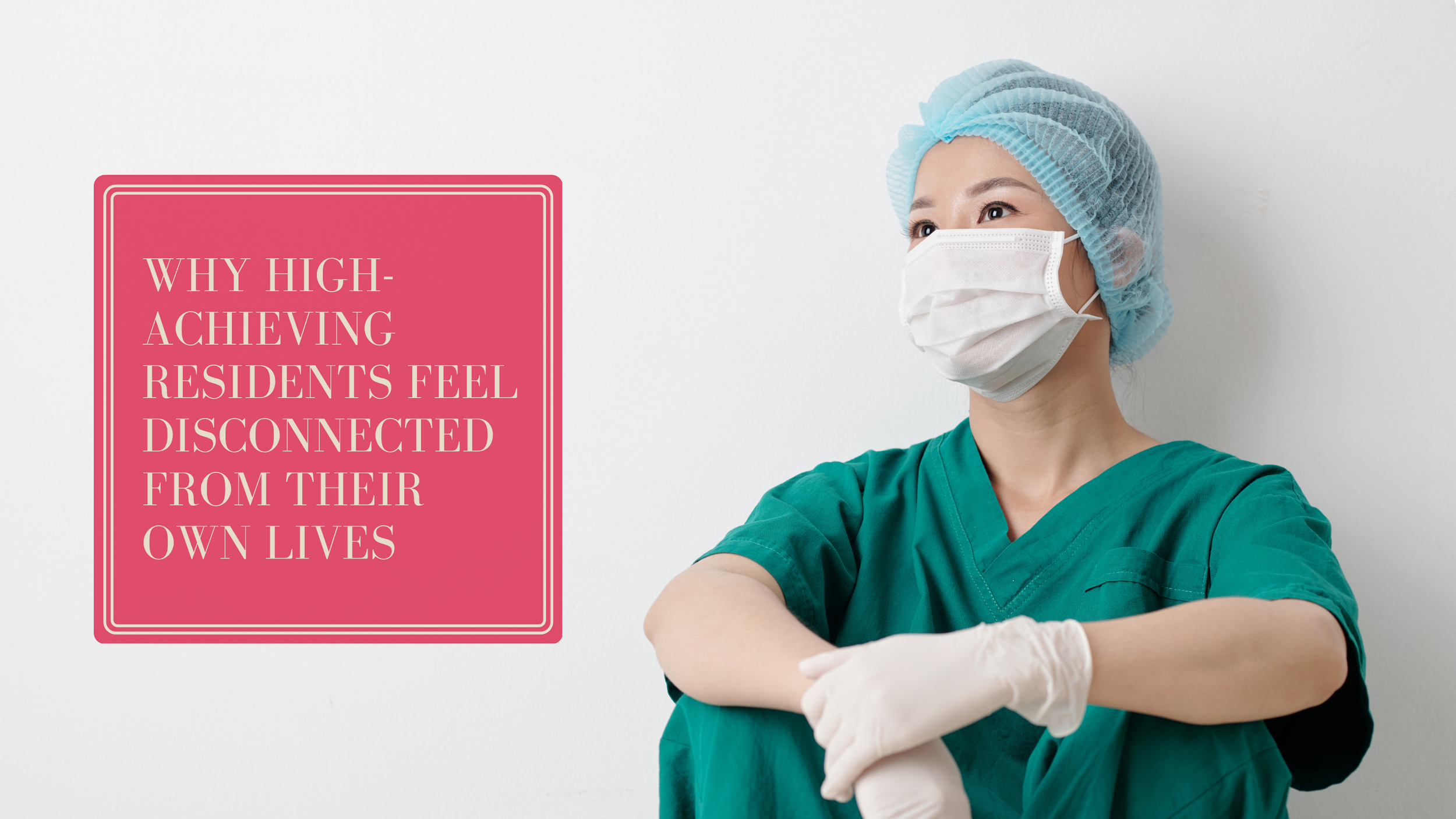
Burned out but still functioning? Learn why high-achieving residents feel disconnected and how to stay grounded during residency training.
Residency does not just demand your time.
It quietly reshapes your internal world.
Many residents reach a point where they are technically succeeding. They are competent. Reliable. Productive. Trusted.
And yet something feels off.
They feel distant from their own lives.
Disconnected from their partners.
Flat on their days off.
This is not burnout in the dramatic sense.
It is subtle nervous system overload.

Residency Trains Vigilance, Not Regulation
The hospital trains you to scan for error.
To anticipate worst-case scenarios.
To carry responsibility that has real consequences.
Over time, your baseline state shifts.
You become efficient under stress.
You perform under pressure.
You function in chaos.
But the nervous system does not easily return to baseline once that becomes normal.
That is why many residents feel alert even when they are home.
Wired even when exhausted.
Detached even when resting.

Why “Work-Life Balance” Advice Fails Physicians
Generic wellness advice assumes flexible schedules and predictable stress.
Residency offers neither.
Balance implies equal distribution.
Residency demands asymmetry.
What residents need is not balance.
They need regulation.
Groundedness under load.
The Hidden Cost of Carrying Hospital Mode Home
When you stay in clinical vigilance mode outside of work:
Conversations feel shorter
Patience decreases
Emotional range narrows
Recovery becomes incomplete
This is not because you care less.
It is because your body has not completed the stress cycle.
High Performers Are the Most At Risk
Ironically, the residents who function best under pressure are the ones most likely to normalize chronic activation.
They think this is just what resilience feels like.
But resilience is not constant activation.
It is the ability to move between activation and recovery.
That movement must be intentional.

Staying Grounded During Residency
Groundedness is not passive relaxation.
It is a skill.
It means being able to:
Downshift intentionally after a shift
Interrupt rumination
Reconnect emotionally when you walk in the door
Protect energy without withdrawing
When residents learn to regulate rather than endure, performance improves and relationships stabilize.
You do not need to overhaul your life.
You need a repeatable system for returning to baseline.
Click here to get my freebie: Stay Grounded Guide